Master Key System Pittsburgh PA
- Registered contractorPA192675
- Insured$1,000,000
- 12 months warrantyOn our work
- 24/7Mobile service
- 5.0 on Google25 reviews
A master key system Pittsburgh PA landlords and businesses can use gives each person a key that opens only their doors, while one master key opens them all. It is planned in advance, door by door, by a technician from our commercial locksmith team, and built into the locks you already have or into new ones.
What Is a Master Key System?
A master key system lets one lock be opened by more than one key. Each door has a change key that opens that door only, and a master key opens every door in the group. Larger systems add levels above that, so a manager's key opens a floor and an owner's key opens the building.
How Master Keying Works Inside the Lock
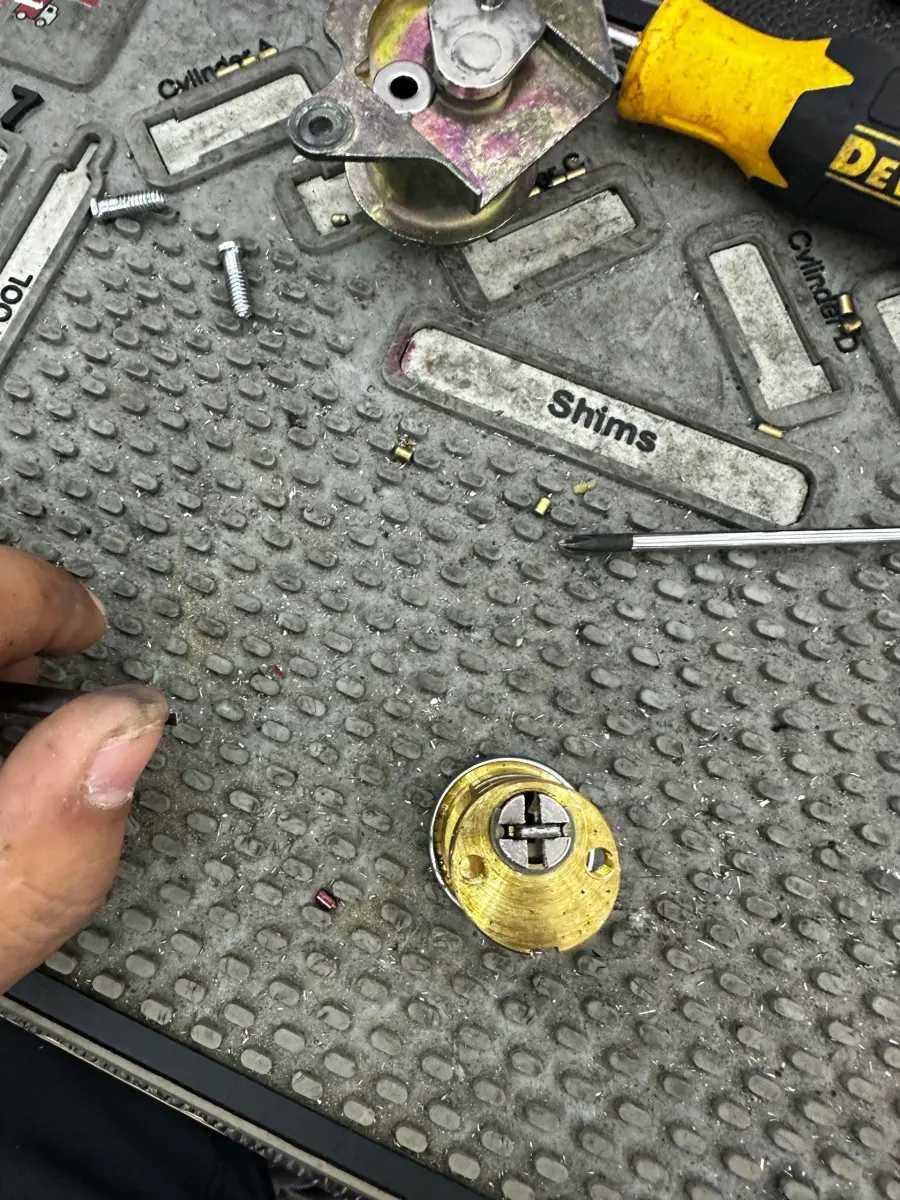
Master keying relies on the pin tumbler design. Each pin stack in a cylinder has an extra thin pin, called a master pin, which creates a second height at which the lock will open. The change key lifts the pins to one set of heights, and the master key lifts them to a second set. Both let the cylinder turn.
The pattern of those heights is worked out on paper first, in a chart that records every key and every door. That chart is the most valuable part of the system, because it lets a locksmith add a new door or a new key later without canceling existing ones, and without creating accidental overlaps.
The Key Levels in a System
A system is described by its levels. A change key is the lowest. A master key opens a group. A grand master key opens several groups. Some very large systems add a great grand master. Each extra level adds complexity, because it also adds ways in which one key could open a door it was not meant to.
Most small and medium buildings use two levels, change keys and one master, or three at most. A technician will suggest the fewest levels that give you the control you need, since simpler systems are easier to manage and keep secure.
- Change key: opens one door, for one person or tenant.
- Master key: opens every door in a defined group, such as one floor or one department.
- Grand master key: opens several master groups, for an owner or building manager.
- Control key: a special key used by the locksmith to remove and replace cylinders without taking the lock apart.
Master Key System Pittsburgh PA: Who Needs One
The systems suit places with many doors and many people. A landlord with several units wants a master key for access and a separate key for each tenant. An office building wants each business to hold keys to its own suite. A school or a clinic wants staff to open the rooms they need and not all the others.
If you have only a few doors, a master system may be more than you need, and keying the doors alike or rekeying may be enough. We will say honestly which suits your premises, because a smaller solution that you can manage is better than a grand plan that nobody keeps up.
Master Keying and Tenant Master Key Arrangements
A tenant master key arrangement gives each tenant one key for their own unit, plus a master held by the landlord or manager for emergencies and inspections. Tenants cannot open each other's units, and the landlord can open any. When a tenant leaves, only that unit needs rekeying, and the master key keeps working.
This is the main reason landlords choose master keying. Without it, a landlord with ten units either carries ten keys or must ask every tenant for access. With it, the landlord has one key for all, and each tenant has one for theirs, with no overlap between the units.
Key Control System and Restricted Keyways
A master system only works if the keys stay under control. Copies made without permission undermine the whole plan. A key control system adds protection by using a restricted keyway: a key profile that a hardware store cannot copy without the owner's written authority. Each key is also stamped with a number and recorded.
Restricted keyway products carry a cost, and they work only if the owner actually checks and records who holds each key. If you are not going to manage keys, a restricted keyway gives less benefit. We will explain the trade-offs before you decide, and let you choose the level of control that matches how you work.
Master Keying Trade-Offs You Should Know
Every master system has a security cost. Because a master pin gives each lock more than one way to open, the lock is a little easier to pick or to attack than one with a single key. The more levels, the greater the effect. A careful design limits this, but it cannot remove it.
The other cost is the risk of a lost master key. A lost change key exposes one door. A lost master key exposes every door in the group, and the response may be to rekey the whole group. Keep master keys few, record who holds each one, and store spares in a locked place, not on a ring in a car.
Starting a System: What the Technician Needs
Planning begins with a walk through the building. The technician lists every door, the type of lock on it, and who needs to open it. From that list they draw the key plan, decide the number of levels, and choose the hardware. You approve the plan before any cylinder is touched, and receive a copy of the chart.
Bring a floor plan if you have one, and a list of the people or tenants who will hold keys. Say whether you expect the building to grow, since it is cheaper to leave room in the plan now than to rebuild it later. Tell us also about any doors with exit devices, which need special care.
Exit routes need particular care. The 2021 International Building Code, chapter 10 on means of egress, controls how doors on a route out of a building may be locked, and which edition applies to a Pennsylvania building is for the local code official to confirm. A key plan must never stop people leaving.
Adding to a System Later
A well-planned system can grow. New doors can be added, new change keys cut, and a new master level inserted, provided the chart is kept and the locksmith who made it, or a successor, can read it. A system with no record has to be worked out again from scratch, which is slow and can lead to errors.
Keep your chart safe, ideally in two places, and treat it as confidential. Anyone who has the chart and a key can work out how to cut a master key. It should be held by the owner or the manager and shared only with the locksmith, not left in a drawer in an office open to staff.
Rekeying Within an Existing System
When a change key is lost, only the affected door needs attention. The technician rekeys that cylinder to a new change key within the system, and the master key continues to work. If a master key is lost, a larger job is needed. See our commercial lock rekey page for how rekeying works, and our exit device rekey page for push bar doors.
Book a Planning Visit
Planning starts with a count of doors and a list of who must open what. Send that through the quote form or phone (412) 504-7574, and a technician will arrange a walk-through of the building. The finished chart is yours to keep.
Frequently Asked Questions
Can you convert the locks I already have?
Often. Many commercial cylinders can be master keyed by changing their pins. The technician will check the locks first and tell you whether any need replacing.
What happens if a master key is lost?
The doors that the master key opens are exposed until something changes. Usually the cylinders are rekeyed to a new master, and new keys are cut for everyone. Tell us at once if one is lost.
Is a master key system less secure?
Slightly, because each lock has more than one way to open. A good design keeps the levels few and the keys controlled. We will tell you how to keep the risk low.
Do I need a restricted keyway?
Only if you want to stop unauthorized copies. It helps when many people hold keys, and when you will record and check who holds each one. For a small system it may be more than you need.
Source: 2021 IBC chapter 10 (ICC)